
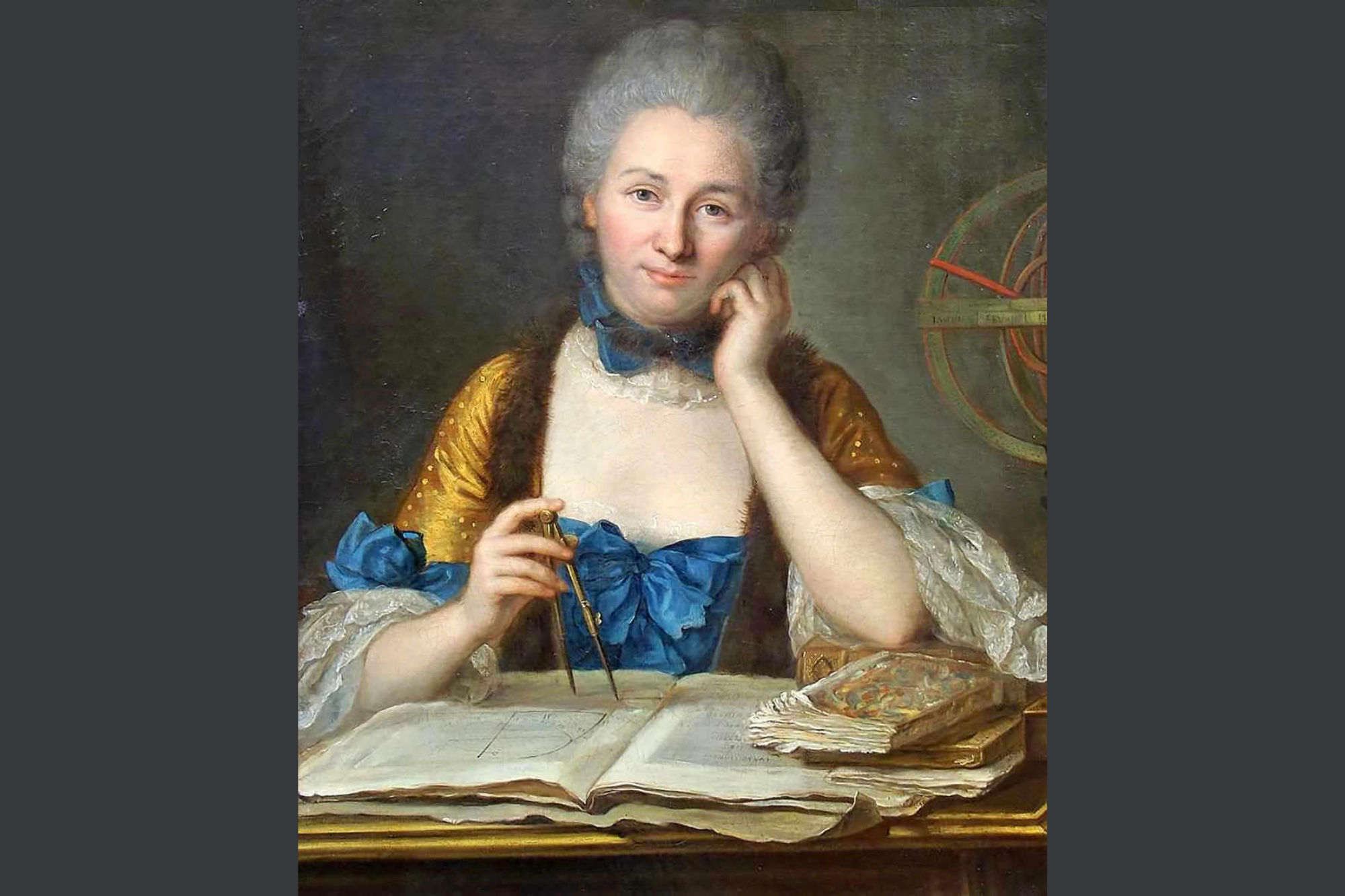

Émilie du Châtelet is one of the most brilliant people to ever live. You’ve probably never heard of her, but you’ve undoubtedly felt the impact of her work.
Born in Paris on December 17th, 1706 given the name of Gabrielle Émilie Le Tonnelier de Breteuil, du Châtelet came into the world at a time when women were expected to live solely in the service of men, focusing on their domestic duties. Their primary area of influence – and educational opportunity – was salons, social gatherings of intellectuals hosted by aristocratic women. The influence women had outside of their homes was supposed to be extremely limited, indirect, and exclusively reserved for the upperclass. From a young age, du Châtelet blatantly flouted these rules.
Du Châtelet expressed an interest in science, math, and other intellectual pursuits early on. Deeming this unladylike, her mother threatened to send her to a convent, but her father intervened and chose instead to nurture her interests. Due to their high standing, du Châtelet’s parents often entertained intellectuals, and as an official of Louis XIV’s, her father was able to set up meetings between du Châtelet and prominent scientists.
Motivated by her passion and with her father’s support, du Châtelet pursued an expansive classical education, studying Latin, Italian, astronomy, and math, among other subjects. By the age of 12, she could speak six languages and was taking lessons in fencing and other sports.
Du Châtelet was something of a risk taker. Since she harbored a special passion for science and math, she needed certain materials, such as very rare and expensive books, as well as lab equipment. However, her sex made it difficult for her to make money in the conventional way.
Thus, from an early age she engaged in gambling, a practice that allowed her to exercise her mind, using her advanced math skills to win while also procuring funds. Due to her standing as an aristocratic woman, this practice was very much frowned upon.
At the age of 18, du Châtelet married Marquis Florent-Claude de Châtelet-Lomont. They had three children together, a daughter and two sons, though their second son died after only a year. At the age of 26, she separated from her husband to focus on her work, and retired to his estate in Cirey with her lovers – something virtually unheard of. Shockingly, her husband was totally fine with this arrangement, and even went as far as to fund her and her lovers’ work.
She had several male lovers over the years, the most notable being the famous philosopher, Voltaire. They met in 1733 and lived together in Cirey for 15 years, even after they were no longer romantically involved.
Voltaire was du Châtelet’s lifelong intellectual companion, and they often worked closely together. She helped him with much of his work, such as the technical parts of his 1738 Eléments de la philosophie de Newton – a fact that Voltaire admitted only indirectly. Voltaire called du Châtelet “a genius worthy of Horace and Newton,” and said she was “a great man whose only fault was being a woman.”
Du Châtelet had an unquenchable thirst for learning, continuing her education even into adulthood. After she married, she hired private tutors for herself. At the time, women weren’t allowed to attend lectures, but she refused to let that get in her way, and so, on one memorable occasion (and perhaps more than once), snuck into a lecture disguised as a man.
Du Châtelet was a philosopher and served as an early feminist, arguing for female secondary education while criticizing the frequent exclusion of women in the public sphere. She wrote the somewhat autobiographical book, Discours sur le bonheur (Discourse on Happiness), arguing that women do not need to ‘reform’ themselves to achieve happiness. In this work, she also subtly combats common stereotypes about women, such as their loving shopping, constantly seeking pleasure, and being oversensitive.
One major philosophical achievement of the Enlightenment was the Encyclopédie (Encyclopedia), compiled by Diderot using work submitted from a range of various acclaimed philosophers such as Rousseau, Montesquieu, and the aforementioned Voltaire. It has long been accepted that du Châtelet’s influence on this volume was little to none. Recently, however, this idea has come under revision.
Du Châtelet’s Institutions de physique was directly sourced by seven different articles, six of which the secretary of the Prussian Academy of Sciences in Berlin, Samuel Formey, had a hand in. The author of the seventh is unknown.
If one were to run Formey’s articles through turnitin.com, a plagiarism-checking website, he would score well above 50% in terms of similarity to du Châtelet’s book. One of his articles, “Contradiction,” would score a 95%.
Currently, scholars are debating whether or not these articles should be credited to du Châtelet or Formey, keeping in mind that Montesquieu is universally considered to be one of the contributors to the Encyclopédie, despite his only contribution being one unfinished article, submitted posthumously.
Though she was an impressive philosopher, du Châtelet’s real passions lay in math and science. She once entered a competition regarding the nature of fire just two weeks before the deadline, doing so anonymously due to her gender and class. In her essay, she disproved the idea that fire is a material substance, stated that different colors of light have different heat capacities, and predicted infrared radiation. Her article received an honorable mention and was later published under the name “young Lady of high rank,” but because there was no one quite like her, everybody knew who wrote it. The article was received positively – for the most part – by scientists, and du Châtelet became the first woman to ever be published by the Paris Academy.
Du Châtelet’s work did not stop there. In her famous Institutions de physique (which served both as a textbook for her son and an original work of natural philosophy) and the second edition Institutions physique, du Châtelet defended force vive, or kinetic energy. One man, Jean-Jacques Dortous de Mairan, secretary of l’Académie royale des sciences, disagreed with her vehemently. He published an extremely patronizing letter, arguing that du Châtelet misunderstood both his and Newton’s work, that her understanding of mathematics was incomplete, and that women in general are fickle.
Du Châtelet responded with an equally patronizing letter, eloquently dismantling his argument point by point and demonstrating her expertise all the while.
She then sent this letter to 500 of his colleagues at Académie and forced him into early retirement.
Throughout her life, du Châtelet made too many discoveries and performed too many experiments to count. She sought a metaphysical base for Newtonian physics, and created a detailed system to do so, which she published in her Institutions Physique.
Du Châtelet’s magnus opus, or masterwork, came in the form of her two volume translation and commentary of Newton’s Principia. It took around four years to complete, with her translating the entire volume, adding 287 pages of additional commentary, and putting in a new mathematical addendum. In her translation, she clarified Newton’s obscure writing, added new findings, and included experiments she had done to prove many of his theories.
It took Halley’s Comet, an event that revived interest in Newton’s work, for Du Châtelet’s Principia to be published, ten years after her death. It remains the leading French translation today.
Du Châtelet’s completion of Principia was just as remarkable as the work itself. When she became pregnant relatively late in life, with the daughter of poet, philosopher, and military officer Jean-François de Saint-Lambert, she knew that she would most likely die. With this knowledge, she set out to finish her masterwork.
The final months before she gave birth were frantic. She worked 17-18 hours a day, often staying up until 5 a.m. She dipped her limbs in ice water and smacked them just to stay awake, writing so fast that she often didn’t lift her quill between words, perpetually staining her fingers with ink.
She finished Principia and gave birth in the same week. She died ten days later. Her daughter passed away as well.
Nowadays, the majority of people have no idea who du Châtelet was or what she accomplished. If they do, she is too often only mentioned as Voltaire’s mistress and muse. The few who know a bit more about her know of her only as a translator and commentator, rather than an accomplished scholar in her own right.
Very recently, du Châtelet has begun to garner more recognition. More books have been written about her, and a few colleges and universities have taken an interest. She is beginning to gain acknowledgement as a prominent Newtonian scholar and philosopher. She even had a Google Doodle created in her honor.
Du Châtelet paved the way for generations of women to break into the male-dominated world of science and mathematics. She overcame obstacle after obstacle, and against all odds made some truly groundbreaking contributions. We must remember all that she fought for, all that she accomplished, and all that she overcame.