


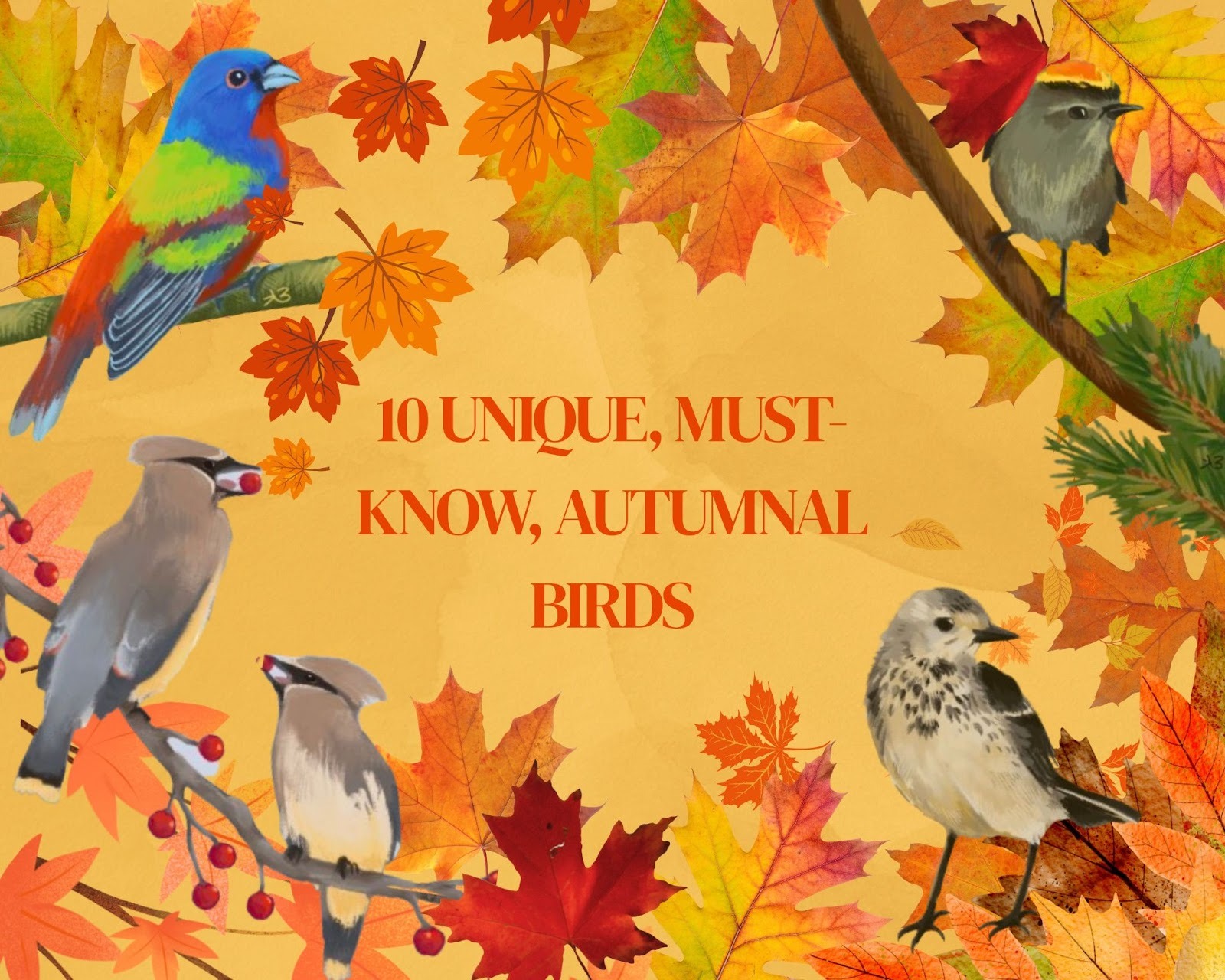
Fall is already here, with winter fast approaching. Just like humans who need to get ready for winter by purchasing parkas and jackets, birds prepare to migrate in order to avoid the cold and to find more resources. Here are 10 unique and interesting birds that are either migratory, autumn-themed, or a combination of the two.
-

Emma Kong Baltimore Oriole

This bird is a must-know Halloween-themed bird with bright orange, black, and white feathers. Found in the eastern United States, the Baltimore Oriole is a fruit-eating bird that lives mainly in open deciduous woodlands. They eat insects in the summer and fruit in the fall, preferring dark-colored fruits. Their nests are extremely distinctive—females meticulously weave thin fibers together to create their sock-shaped, hanging nests.

- Eastern Meadowlark
With a similar color palette to the Baltimore Oriole, the Eastern Meadowlark is characterized by a bright orange-yellow chest marked with a black “V” as well as speckled black and white wings. This bird lives in places with dense grass, such as grasslands and prairies. Contrary to its name, the Eastern Meadowlark is not actually a lark; instead, it is part of the blackbird family (Icteridae). What’s especially unique about this bird is not its name, however, but its changing, seasonal diet. In the spring, they feed on various types of grubs and caterpillars. In the summer, their diet shifts to mainly insects. Finally, in the winter, they mostly feed on seeds and grains.
-

Emma Kong Common Loon

While somewhat lacking in color, this bird makes up for it with its eerie, harrowing call that is commonly used in horror movies. Common loons are both agile swimmers and fast flyers. Living mainly along bodies of water, these birds are powerful swimmers who feed on fish. Surprisingly, though, they are similar to airplanes, requiring “a long ‘runway’ to take off for flight,” according to the National Wildlife Federation.

- Golden-crowned Kinglet
The Golden-crowned Kinglet is a tiny, pale yellow, sparrow-sized bird most identifiable by its bright orange-yellow “crown” that is raised when confronting other males, hence the name. Their diet consists mainly of insects, and they are constantly foraging for food to fuel their high body temperature and to combat the cold. As a result, they often hang upside down while searching for food because it gives them ample access to more food sources. Despite their small size, these birds can withstand temperatures of as low as -40 degrees Fahrenheit.
-

Emma Kong Cedar Waxwing

Characterized by smooth, waxy feathers, the Cedar Waxwing, like many other birds, migrates south in the fall to warmer temperatures and more resources. The bird gets its name from the waxy red tips on their secondary wing feathers and is one of few fruit-eating birds in North America. Since fruit makes up the majority of this bird’s diet, the Cedar Waxwing can sometimes overindulge on fermented berries, leading to intoxication or even death. So, if you’ve ever seen a tipsy bird flying around, it most likely just needs a few hours to sober up.

- Painted Bunting
This colorful, vivid bird is the living embodiment of the rainbow. In French, their name, nonpareil, means “without equal.” Painted Buntings prefer areas with low, dense foliage and feed primarily on seeds and insects. They are present mainly in the southern United States, migrating to Florida and the Caribbean in the fall. Beginning their fall migration before molting, western Painted Buntings are a rare songbird that has a migration-molt pattern. Due to their colorful nature, however, many Painted Buntings are unfortunately illegally trapped and sold for money.
-

Emma Kong Rufous Hummingbird

The Rufous Hummingbird is extremely small, with both females and males measuring only 7-9 centimeters in length and weighing 2-5 grams. Males are bright orange and rufous-colored—hence their name—with an iridescent throat, and females are mostly green with a spot of orange on the throat. This bird’s diet consists of flowers and insects, and they feed while hovering. To feed their young, females regurgitate tiny insects mixed with nectar. Even though they are one of the smallest birds, they are extremely territorial and have been known to chase chipmunks away from their nests.

- American Pipit
This bird is most known for foraging and their distinctive call from which they got their name. These small and slender birds spend their time in the arctic tundra until their appearance during the fall and winter seasons where they can be seen throughout the more northern parts of North America. Despite their decline in population, these birds are incredibly resilient; after 17 nests of an alpine population in the Beartooth Mountains of Wyoming were covered with snow for 24 hours, all the chicks that were 11 days or older survived.
-

Emma Kong Scarlet Tanager

The Scarlet Tanager, most known for its striking, blood-red plumage contrasted with inky black wings, is a stunning bird of the autumn season. Not only are its colors a perfect representation of the season’s spookier atmosphere, but it is also migratory during the fall. These birds will often join flocks of various other birds to feed during migration and on their winter grounds of South America.

- Tufted Titmouse
Last, but certainly not least, is the Tufted Titmouse! The Tufted Titmouse is most recognized for the tuft on the top of its head. Its scientific name, Baeolophus (Greek origin), even means “crest” and “small”. This adorable bird in the family Paridae is nonmigratory in the Eastern United States. Although they are nonmigratory, they are most active during the fall and winter months where they forage for insects, seeds, and fruit.
Conclusion
These are just ten of the thousands of bird species that are bundling up for the winter.
So, as the leaves fall and the weather grows colder, be sure to look out for these 10 birds—and others—who uplift our spirits no matter the weather.